

Digital Manufacturing Helps Medtech Firm Improve Patient Outcomes
HemoSonics used 3D printing, CNC machining, and injection molding to quickly develop blood analysis machine
As often happens in the medical industry, innovative ideas, hatched in university research settings, spawn innovative companies, which create innovative products. A case in point:HemoSonics.
The Charlottesville, Virginia-based medical device company was started in 2005 by two professors and a post-doctoral research student at theUniversity of Virginia School of Medicine’s Bio-Medical Engineering program那沃克,迈克·劳伦斯和弗朗西斯科·中提琴respectively. The trio identified a method for measuring the stiffness of blood clots by using ultra-sound imaging technology, and created a system built around that technology to improve patient outcomes and reduce costs.
A number of years followed of extensive research and development, which included securing key patents, conducting more than 20 hospital studies, and consulting with physicians and other clinicians.
More recently, HemoSonics has been prepping to bring its Quantra System diagnostic products to market, withprototyping and end-use manufacturing help from Protolabs. In fact,Protolabs曾与HemoSonics自2011, from those early R&D days to more recent, end-use production work on the Quantra System.
HemoSonics successfully launched its products commercially last year in Europe, and hopes to enter the U.S. market soon. After being acquired in 2017 byStago Group—A French medical technology company with more than 2,400 employees worldwide—HemoSonics has expanded its offices into Durham, North Carolina, and has grown to 50-plus employees.
A Need for Speed and Flexibility, Solved by an Agile Supplier
In HemoSonics’ early research and development days, engineers were “iterating through multiple designs under tight deadlines,” said Andy Homyk, senior engineer, who joined the company more than six years ago when it had just five employees. “We were on a tight timeline because, frankly, our funding was limited. So we needed a supplier who could machine parts for us quickly, within a couple of days.”
A number of suppliers contacted could not meet those challenging deadlines. Protolabs could, Homyk remembered. “The difference in lead times was dramatic.”
That was in 2012. Since that time, Protolabs has produced hundreds of prototypes and thousands of components for HemoSonics, using3D printing,CNC machining, and2022世界杯足球赛时间表—for a variety of projects and parts: robotic fixturing, thermal control units, pneumatic manifolds, and more.
“Speed and flexibility—being able to deploy different manufacturing options—and a commitment to customer service, are the main reasons we use Protolabs,” Homyk said.
| At A Glance |
|---|
Slash the time of the prototyping process: Engineers at HemoSonics were iterating through designs rapidly under tight deadlines during the company’s early years of R&D, and needed a contract manufacturer that could machine parts quickly. On a more recent project, HemoSonics engineers needed prototype parts about the size of a computer monitor for the casing around the Quantra System blood-clot analysis machine. The prototypes were to demonstrate form, fit, and function of the Quantra System to physicians at various hospitals.  Solution SolutionProduce custom prototypes for several design iterations within days using quick-turn digital manufacturing. Machining was implemented for some products, and more recently, 3D printing and injection molding for the casing for the Quantra System products. Engineers also used some finishing options for injection molding, including heat staking and pad printing.
Following years of research and development that included securing key patents, conducting more than 20 hospital studies, and consulting with physicians and other clinicians, Quantra System products are now on the market in Europe and will launch soon in the United States. |


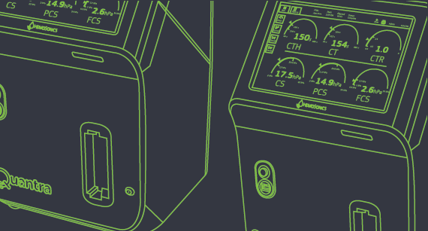
More recently, HemoSonics looked to Protolabs for help with the “skins” or casings that fit around the Quantra blood-clot analysis machines, Homyk explained. HemoSonics engineers needed design prototypes about the size of a computer monitor—first using 3D printing and then injection molding—to demonstrate form, fit, and function of the Quantra System machine to physicians at various hospitals.
The Quantra System is designed as a rapid, easy-to-use diagnostic platform that uses disposable cartridges to conduct a panel of tests. The initial QPlus Cartridge measures the treatable aspects of coagulation in under 15 minutes. The Quantra Hemostasis Analyzer is designed for use in critical care settings that require results to be generated quickly from an instrument that is easy to operate at the point of care.
A challenge emerged when the project switched from additive manufacturing to injection molding. “These are pretty big parts, so one of the molding challenges, in prototyping, was color matching,” Homyk said.

Molding Materials and Finishing Touches
HemoSonics wanted these casings Pantone color-matched to its marketing department’s specifications. One of the ways Protolabs normally does that, in the injection molding process, is to take the plastic resin in the natural color of the specific material chosen, apply around a 3 percent salt-and-pepper mix of colored resins, and final parts are typically very close to the preferred color. But, because HemoSonics parts were so big, some swirling and flow marks were showing up on them. “They did not look good cosmetically in the first batch of parts,” Homyk remembered.
Undaunted, Protolabs went to one of its plastic resin suppliers and the supplier collaborated with Protolabs and HemoSonics to pre-compound the colors. “They mixed the plastic with the dye before molding to get pellets with a nice uniform color,” Homyk said. This custom, pre-colored resin produced flawless parts. “This again speaks to Protolabs’ customer service going the extra mile, and to how agile the company can be.”
Material selectionwas also carefully considered, Homyk said, given that a requirement of almost any kind of medical device is that it needs to meet certain flammability standards. For the casings, HemoSonics opted for an ABS plastic that met those standards and also offered durability.
Beyond machining, 3D printing, and injection molding, HemoSonics engineers also used some additional finishing options on the injection-molded parts, such as heat staking and pad printing. Heat staking is a process that uses a heated stake to melt metal threaded inserts into plastic parts. This makes it so that screws can be used to attach the Quantra casing parts to a frame, for example.

The Outcome? Quantra System Launched in Europe, Coming Soon to U.S.
Those long years of research and development, multiple design iterations and prototypes, more than 20 hospital studies, scores of visits to physicians and other clinicians, the securing of key patents, and the landing of important certifications in Europe—including theCE Mark, which is the equivalent of FDA approval in Europe—is finally paying off, Homyk said. Last year, Quantra System products launched in Europe, and company leaders hope to launch the Quantra system soon in the U.S.
Going forward, Homyk expects Protolabs to continue to play a key supplier role to support the company’s work. “We pick you guys (Protolabs) because of familiarity, speed of production, flexibility, and exceptional customer service.” Beyond producing some fixturing for some reliability testing units, Homyk said nothing major is in the works for now, because, he said with a smile, “We’re pretty pre-occupied with our U.S. launch at this stage. We’re keeping our eyes on the prize.”